
Plastic Strip Nail Gun: An Efficient Fastening Tool Empowering Multiple Industries
In fields such as construction, furniture manufacturing, and interior decoration, fastening work is a crucial link ensuring project quality and efficiency. The traditional manual hammering and fastening method is not only time-consuming and labor-intensive but also difficult to guarantee the accuracy and consistency of fastening. The emergence of the plastic strip nail gun has completely changed this situation. As an efficient tool specially designed for driving plastic strip nails, it has become an indispensable "right-hand man" in various industries due to its advantages of speed, precision, and labor-saving. This article will in-depth analyze the plastic strip nail gun from multiple dimensions, allowing you to fully understand this modern working tool.
I. What is a Plastic Strip Nail Gun? Definition and Core Value
A plastic strip nail gun is a tool that uses power sources such as compressed air, electricity, or gas to quickly and stably drive neatly arranged and bonded plastic strip nails into substrates like wood, plastic, metal, and walls, achieving material connection and fixation. Its core value lies in breaking the limitations of traditional manual fastening, improving fastening efficiency through mechanized operations, while ensuring the accuracy of nailing depth and position, and reducing substrate damage. It is suitable for various application scenarios such as furniture assembly, door and window installation, decorative strip fixation, ceiling construction, and house frame erection. Compared with single-nail manual tools, plastic strip nail guns can realize continuous operation, greatly reducing labor intensity; compared with ordinary nail guns, the plastic strip nails they adapt to are bonded by plastic strips, with more neat arrangement and smoother nail feeding, which can effectively reduce nail jamming failures.
II. Classification Analysis: Characteristics and Application Scenarios of Different Types of Plastic Strip Nail Guns
According to different power sources, plastic strip nail guns are mainly divided into three categories: pneumatic, electric, and gas-powered. Each type of product has differences in structure, performance, and application scenarios, which can meet different operational needs:
1. Pneumatic Plastic Strip Nail Gun
This is currently the most widely used type in the industry, using compressed air generated by an air compressor as the power source. Its core advantages are strong power, high striking frequency, stable operation, simple body structure, and low maintenance cost. Application scenarios include heavy-duty construction (such as house frame erection, wooden beam fixation), medium-sized decoration (such as door and window installation, wardrobe assembly), etc. It needs to be matched with an air compressor and air pipe during use. Although limited by the air source, it has obvious advantages in fixed operation sites (such as decoration construction sites, furniture factories). When purchasing, attention should be paid to the working pressure range (usually 0.4-0.8MPa) to ensure matching with the air compressor.
2. Electric Plastic Strip Nail Gun
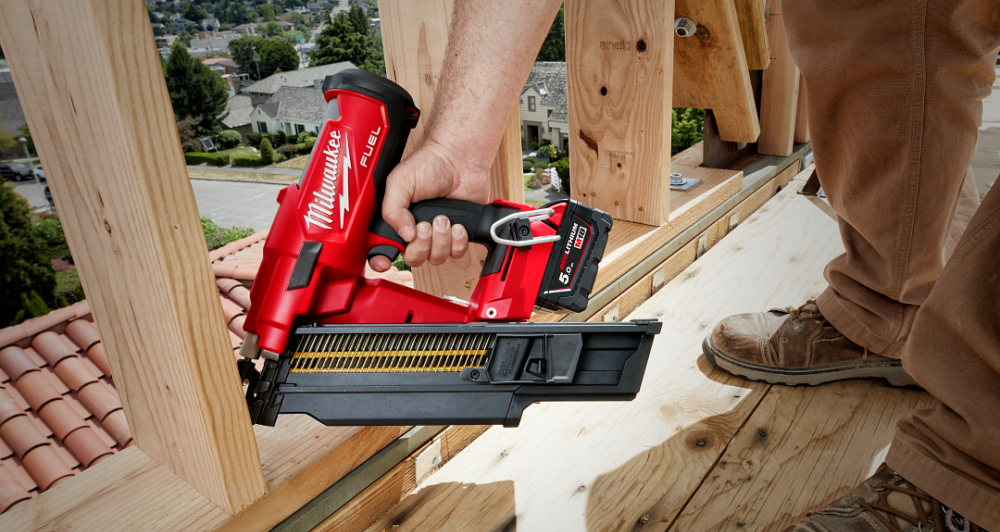
Powered by a rechargeable lithium battery, it does not require an air source or air pipe, and has extremely strong portability, suitable for outdoor operations or scenarios with high mobility (such as high-altitude ceiling construction, outdoor guardrail installation). Its working principle is to drive the transmission mechanism through the motor, convert the rotational motion of the motor into the linear reciprocating motion of the firing pin, and realize the nailing action. According to different powers, it can be divided into light-duty (suitable for decorative strip, skirting line fixation) and heavy-duty (suitable for small frame erection) categories. The advantages are flexible operation and low noise; the disadvantages are limited battery life and relatively heavy body for high-power models.
3. Gas-Powered Plastic Strip Nail Gun
It adopts a power mode combining gas fuel and a spring, and drives the firing pin through the explosive force generated by igniting the gas. Its biggest advantage is completely getting rid of the limitations of air source and power supply, with portability far exceeding that of pneumatic and electric models, and strong power, which can be used for fastening operations on concrete substrates (such as light partition wall fixation). Application scenarios are mainly outdoor construction without power supply and air source, such as building exterior wall decoration and temporary construction site facility erection. However, the gas tank needs to be replaced regularly, the use cost is relatively high, and there are certain requirements for the ventilation conditions of the use environment.
4. Specialized Models Classified by Operation Scenarios
In addition to classification by power source, plastic strip nail guns can also be subdivided according to operational needs: ① Frame plastic strip nail gun: sturdy body, strong power, adaptable to long-size plastic strip nails, specially designed for heavy-duty projects such as house frames and wooden structures; ② Decorative plastic strip nail gun: high precision, soft striking force, adaptable to fine nails, suitable for fine operations such as decorative strips, frames, and cabinet door panels, which can avoid substrate cracking; ③ Roof-specific plastic strip nail gun: equipped with a large-capacity coil nail magazine, capable of continuous nailing, specially used for fixing roof tiles and waterproof rolls; ④ Brad nail gun: a type of light-duty decorative nail gun, using extremely fine Brad nails, suitable for detailed work such as wood splicing and ornament fixation.
III. In-Depth Disassembly: Core Structure and Working Principle of Plastic Strip Nail Gun
1. Core Structure Composition
Regardless of the type, the core structure of a plastic strip nail gun is designed around the three core functions of "power transmission - nail feeding - firing", mainly including:
Gun body: composed of gun body shell, cylinder (pneumatic/gas-powered models), motor (electric models), firing pin assembly, buffer pad, and gun nozzle. Among them, the firing pin is the core of firing, directly contacting and pushing the plastic strip nails; the gun nozzle can adjust the nailing depth to adapt to substrates of different thicknesses; the buffer pad is used to absorb the impact force after firing and extend the service life of the gun body.
Magazine system: including fixed magazine, movable magazine, compression spring/tension spring and other components. The plastic strip nail strip is inserted through the magazine, and the compression spring/tension spring continuously exerts pressure to gradually push the nail strip to the firing position, ensuring smooth continuous nail feeding and reducing the risk of nail jamming.
Control components: including trigger, safety switch, pressure adjustment knob (pneumatic models), power display (electric models), etc. The safety switch can prevent accidental triggering and improve operational safety; the pressure adjustment knob can adjust the striking force according to the hardness of the substrate to avoid over-driving or under-driving the nail.
2. Core Working Principle
The working principles of models with different power sources are slightly different, but the core logic is "power drives the firing pin, and the firing pin pushes the plastic strip nail":
Pneumatic model: High-pressure gas generated by the air compressor enters the gun body cylinder through the air pipe. After pulling the trigger, the gas pushes the piston in the cylinder to move, driving the firing pin to impact the plastic strip nail at high speed and drive it into the substrate; after firing, the return spring drives the firing pin and piston to return to their original positions, completing a cycle.
Electric model: The battery supplies power to drive the motor to rotate, and converts the rotational motion into the linear reciprocating motion of the firing pin through transmission mechanisms such as gears and crankshafts; when the trigger is pulled, the firing pin moves forward rapidly under the drive of the motor to fire the plastic strip nail, and is brought back by the return mechanism after completion.
Gas-powered model: The gas in the gas tank enters the combustion chamber. When the trigger is pulled, the spring drives the piston to compress the gas in the combustion chamber, and the igniter ignites the gas at the same time. The instantaneous impact force generated by the gas explosion pushes the firing pin to fire the plastic strip nail; after the explosion, the exhaust gas is discharged, and the piston resets to wait for the next firing.
IV. Safe and Efficient Use: Operation Specifications and Precautions for Plastic Strip Nail Guns
Plastic strip nail guns are high-speed firing tools, and correct operation is the key to ensuring safety and operational quality. The following operation specifications must be strictly followed:
1. Pre-Operation Preparation
Tool inspection: Check whether the gun body is intact and whether components such as the firing pin, magazine, and gun nozzle are loose or damaged; for pneumatic models, check whether the air pipe connection is tight and free of air leakage; for electric models, confirm that the battery power is sufficient; for gas-powered models, check whether the gas tank seal is good.
Environment and protection: The operation site should be cleaned of debris to avoid obstacles affecting the operation; operators must wear goggles (to prevent debris splashing) and non-slip gloves (to improve grip stability); safety belts must be worn for high-altitude operations; gas-powered models should be used in well-ventilated environments, away from fire sources.
Parameter debugging: Adjust the firing parameters according to the hardness of the substrate, such as adjusting the air compressor pressure for pneumatic models, switching power gears for electric models, and adjusting the nailing depth with the gun nozzle to ensure that the nail is completely embedded in the substrate without damaging the surface.
2. Operation Process
Nail loading: Insert the plastic strip nail strip neatly into the magazine, ensuring that the nail strip fits the magazine guide rail and the plastic bonding strip faces the correct direction; push the magazine in place, and a "click" sound indicates that the nail loading is completed. The magazine can be pulled to test whether the nail feeding is smooth.
Firing: Hold the gun handle, align the gun nozzle vertically with the fastening position, and ensure that the gun nozzle is closely attached to the substrate (avoid dry firing, which is easy to damage the firing pin); pull the trigger with the index finger with uniform force, and release the trigger only after the nail is completely driven in, then move to the next position.
Continuous operation: If nail jamming occurs, first turn off the air source/power supply, take out the remaining nail strips, then use tools to clear the jammed nails. It is strictly prohibited to disassemble the gun body without cutting off the power supply/air source; if abnormalities such as overheating of the gun body or abnormal noise are found during operation, stop using it immediately and troubleshoot the fault.
3. Post-Operation Arrangement
After completing the operation, turn off the air source/power supply and take out the remaining plastic strip nail strips in the magazine; wipe the dust and debris on the surface of the gun body with a clean cloth, and apply lubricating oil to the moving parts such as the gun nozzle and magazine (pneumatic models need to focus on lubricating the cylinder); store the tool in a dry, ventilated place out of the reach of children, and store the battery of electric models separately and charge and maintain it regularly.
V. Maintenance: The Key to Extending the Service Life of Plastic Strip Nail Guns
Reasonable maintenance can effectively reduce failures and extend the service life of the tool. The maintenance focus of different types of plastic strip nail guns is slightly different:
Pneumatic models: Regularly check the tightness of the air pipe joints to avoid air leakage; apply special pneumatic tool lubricating oil to the cylinder and firing pin after each use to prevent component rust; when not in use for a long time, drain the residual gas in the air compressor and air pipe, and disassemble the gun body to clean internal impurities.
Electric models: Avoid over-discharging the battery and charge it in time after use; store the battery away from high-temperature and humid environments, and regularly check whether the battery contacts are oxidized; if abnormal noise occurs during motor operation, disassemble and check the gear wear and replace damaged components in time.
Gas-powered models: Regularly clean the carbon deposits in the combustion chamber to avoid affecting ignition efficiency; check the tightness of the gas tank interface to prevent gas leakage; apply lubricating oil to the spring components regularly to ensure smooth reset.
VI. Conclusion: Industrial Value and Development Trend of Plastic Strip Nail Guns
As a representative of mechanized fastening tools, plastic strip nail guns not only improve the operational efficiency and quality of various industries but also promote the upgrading of construction modes, transforming from traditional "heavy physical labor and low efficiency" to "light operation and high precision". With the development of technology, plastic strip nail guns will move towards a more portable and intelligent direction in the future, such as improving the battery life of electric models, intelligent pressure adjustment functions (automatically adapting to substrate hardness), fault early warning systems, etc., which will further reduce the operation threshold and improve the use safety.
For practitioners, choosing a plastic strip nail gun suitable for the scenario, following standard operations and doing a good job in daily maintenance can not only give full play to the performance of the tool but also ensure operational safety and project quality. Whether it is a professional construction team or an individual DIY enthusiast, mastering the relevant knowledge of plastic strip nail guns can make fastening work more efficient and easier.

 Send Email
 Whatsapp