
Complete Analysis of Classification and Applications of Coil Nails
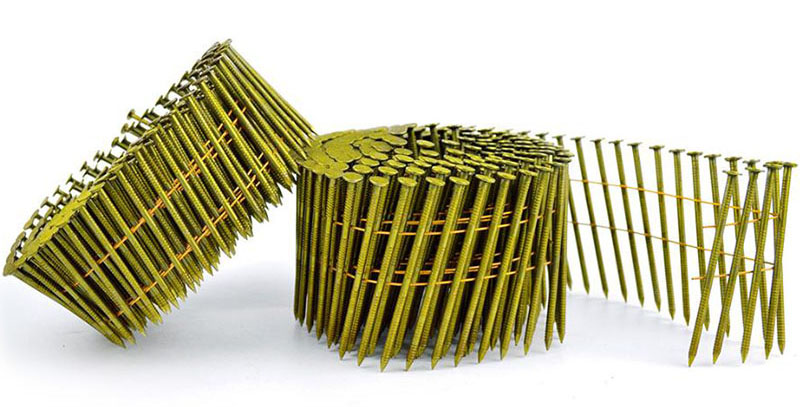
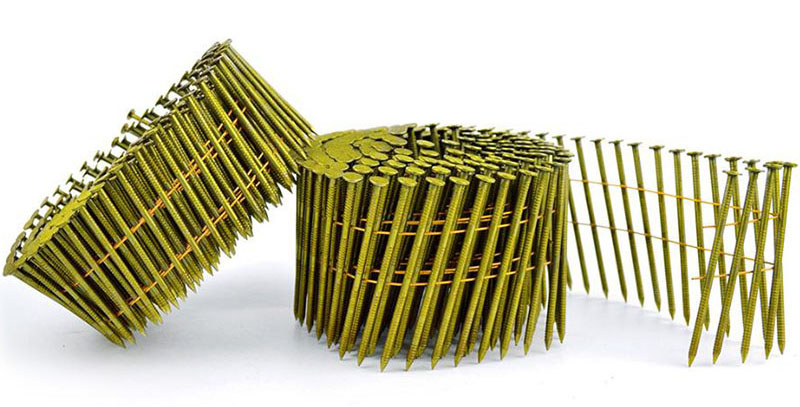
In the fastener field, coil nails have become a key consumable in automated nailing scenarios due to their core advantages of "continuous nail feeding and efficient operation". They integrate individual nails into a coil shape through special adhesive bonding or wire connection, which is compatible with coil nail guns to achieve uninterrupted nailing, greatly improving the operation efficiency of industries such as wood processing, construction, and logistics packaging. Compared with traditional individual loose nails, coil nails not only reduce the time cost of frequent nail loading but also ensure the consistency of nailing precision. Therefore, they are widely used in various heavy-load fixing and mass production scenarios. This article will comprehensively analyze the classification system of coil nails from three core dimensions: structure, material, and application, and sort out their typical application scenarios in combination with the characteristics of various products.
I. Classification by Structure and Connection Method: Adapting to Different Operation Precision Requirements
The structural design of coil nails directly determines their nail feeding stability, operation residues, and surface aesthetics. According to the different connection methods, they can be divided into two categories: adhesive-bonded coil nails and wire-connected coil nails. The two have significant differences in core characteristics and application scenarios.
(1) Adhesive-Bonded Coil Nails: The Preferred Choice for Precision Operations
Adhesive-bonded coil nails are formed by bonding individual round nails into a coil at fixed intervals with special environmentally friendly adhesive. The nail shanks remain smooth without additional metal connectors. Their core advantage is that there are no wire residues during the nailing process, the nail holes are small and flat, which can maximize the surface integrity of the fixed workpieces. At the same time, the adhesive-bonded coil nails are closely arranged, the nail feeding process is smooth, and jamming is not easy to occur. They can complete the operation with medium and low-power coil nail guns.
In terms of application scenarios, adhesive-bonded coil nails are mainly oriented to fields with high requirements for surface precision. For example, the assembly of panel furniture in furniture manufacturing, the fixing of cabinet backplanes and cabinets, the installation of decorative lines; the splicing of boards in fine woodworking, the auxiliary fixing of tenon-and-mortise structures; as well as gift packaging, the production of precision wooden boxes, etc. In addition, in scenarios such as the fixing of lightweight boards and the installation of skirting lines in interior decoration, adhesive-bonded coil nails are also favored for their "trace-free" operation effect.
(2) Wire-Connected Coil Nails: The Core Support for Heavy-Load Scenarios
Wire-connected coil nails use high-strength metal wire to connect individual nails into a coil at the nail cap. Their connection strength is much higher than that of adhesive-bonded coil nails, and they can be compatible with high-frequency and high-intensity nailing operations of high-power coil nail guns. Due to the traction of the metal wire, the wire-connected coil nails have stronger tensile strength during the nailing process. Even in the face of high-density wood or heavy-load fixing requirements, they can ensure the stability of the nail shank and prevent loosening or falling off. It should be noted that a small amount of metal wire will remain after nailing with wire-connected coil nails, which needs to be cleaned up subsequently.
Based on their heavy-load adaptation characteristics, wire-connected coil nails are widely used in scenarios with extremely high requirements for fixing strength. For example, the fixing of panels and supporting wooden squares of large wooden pallets and skids, the packaging of heavy goods in wooden boxes in the logistics packaging industry; the connection of beams and columns of wooden structure houses, the fixing of roof purlins, the installation of scaffolding planks in the construction field; as well as the installation of container floor panels, the fixing of large formwork and other industrial scenarios. In these scenarios, the continuous operation capability and stability of wire-connected coil nails can effectively improve construction efficiency and project quality.
II. Classification by Material and Surface Treatment: Adapting to Different Environmental Weather Resistance Requirements
The material and surface treatment of coil nails directly determine their corrosion resistance, rust resistance, and service life. According to the differences in the use environment, they can be divided into three categories: ordinary carbon steel coil nails, galvanized coil nails, and stainless steel coil nails, which are respectively suitable for different scenarios such as dry indoor, outdoor humid, and harsh corrosive environments.
(1) Ordinary Carbon Steel Coil Nails: An Economical and Practical Choice for Indoor Use
Ordinary carbon steel coil nails are made of high-quality low-carbon steel, with low cost, moderate hardness, and good processing performance, which can meet the fixing requirements of general dry indoor environments. However, due to the fact that carbon steel itself does not have rust resistance, it is prone to rust when exposed to humid environments for a long time, leading to a decrease in fixing strength. Therefore, it is not suitable for outdoor or humid environments.
Its typical application scenarios include the production of indoor disposable wooden boxes, temporary construction fixing, auxiliary fixing of indoor furniture, short-term fixing of lightweight boards, etc. In these scenarios, due to the dry environment and low requirements for service life, ordinary carbon steel coil nails can complete the fixing task with high cost performance.
(2) Galvanized Coil Nails: The Preferred Choice for Rust and Moisture Prevention Outdoors
Galvanized coil nails are processed by hot-dip galvanizing or electro-galvanizing on the surface of carbon steel coil nails. The galvanized layer can form an effective protective barrier, isolating air and moisture from eroding the nail shank, greatly improving its rust and moisture resistance, and its corrosion resistance is much better than that of ordinary carbon steel coil nails. Among them, hot-dip galvanized coil nails have a thicker galvanized layer, better rust prevention effect, and longer service life, suitable for long-term outdoor environments; electro-galvanized coil nails have a thinner galvanized layer, slightly weaker rust prevention effect, but relatively lower cost, suitable for mild humid environments.
The application scenarios of galvanized coil nails are mainly concentrated in outdoor or humid environments, such as outdoor wooden structure construction (such as wooden houses, wooden plank roads), the construction of open-air shelves, the installation of garden fences, the fixing of outdoor billboards; logistics scenarios requiring moisture and rust prevention such as marine wooden pallets and container packaging; as well as the fixing of lightweight boards in indoor humid areas such as bathrooms and kitchens.
(3) Stainless Steel Coil Nails: Suitable for Harsh Corrosive Environments
Stainless steel coil nails are made of 304 or 316 stainless steel, with excellent acid and alkali resistance and corrosion resistance. They can be used for a long time in harsh environments such as coastal high salt spray, chemical corrosion, high temperature and high humidity without rusting, and the fixing strength is stable for a long time. Among them, 316 stainless steel coil nails have stronger corrosion resistance, suitable for extreme corrosive environments such as chemical industry and coastal areas; 304 stainless steel coil nails are suitable for general corrosive environments with higher cost performance.
Its typical application scenarios include construction in coastal areas, packaging and fixing of chemical equipment, installation of shelves in food processing workshops (which need to meet hygiene and corrosion resistance requirements), manufacturing of high-end outdoor furniture, fixing of mariculture equipment, etc. In these scenarios, the core advantage of corrosion resistance of stainless steel coil nails can effectively ensure the safety and service life of the fixed structure.
III. Classification by Application and Nail Type: Precisely Matching Industry-Specific Needs
In addition to classification by structure and material, coil nails can also be subdivided according to specific applications and nail type specifications. Different subdivided types of coil nails have targeted optimizations in nail length, nail diameter, and nail cap design, precisely matching the specific needs of different industries.
(1) Pallet Coil Nails: The Main Consumable in the Logistics Packaging Industry
Pallet coil nails are a type of coil nail specially designed for the production of wooden pallets and skids. In terms of specifications, they are mainly long nails with a nail length usually between 50-100mm and a nail diameter of 2.8-3.8mm. Most of them adopt a wire-connected structure to ensure fixing strength. Some pallet coil nails also adopt a threaded nail shank design, which can further improve the bite force with wood and prevent the pallet from loosening during heavy load and frequent handling.
Its core application scenario is the fixing of panels and supporting wooden squares of wooden pallets and skids, which is the core fastener in the logistics packaging and warehousing and transportation industries. Whether it is ordinary cargo pallets or heavy equipment pallets, the continuous operation capability of pallet coil nails can greatly improve the efficiency of pallet production and ensure the load-bearing stability of pallets.
(2) Furniture Coil Nails: Special Consumables for Fine Woodworking
Furniture coil nails are designed for the precision needs of furniture manufacturing. In terms of specifications, they are mainly short and thin nails with a nail length usually between 20-50mm and a nail diameter of 1.8-2.5mm. Most of them adopt an adhesive-bonded structure, with no wire residues after nailing, ensuring the surface beauty of furniture. The nail caps mostly adopt a countersunk head design, which can be embedded into the wood to avoid protruding and affecting the appearance of the furniture.
Its core application scenarios include panel furniture assembly, cabinet backplane fixing, drawer guide rail installation, decorative line fixing, auxiliary fixing of sofa frames, etc. In high-end furniture manufacturing, the precision nailing characteristics of furniture coil nails can effectively ensure the assembly precision and surface integrity of furniture.
(3) Construction Coil Nails: Heavy-Load Consumables for Engineering Construction
Construction coil nails are heavy-load coil nails designed for construction scenarios. In terms of specifications, they are mainly ultra-long and thick nails with a nail length usually between 80-150mm and a nail diameter of 3.5-4.2mm. All adopt a wire-connected structure, compatible with high-power coil nail guns, and can penetrate high-density wood and building boards. The nail shanks are mostly made of high-strength carbon steel, and some products are also quenched to improve hardness and tensile strength.
Its core application scenarios include the connection of beams and columns of wooden structure houses, the fixing of roof purlins and roof panels, the installation of scaffolding planks, the fixing of building formwork, outdoor anti-corrosion wood projects, etc. In these scenarios, the high strength and continuous operation capability of construction coil nails can effectively improve construction efficiency and ensure the stability of the project structure.
IV. Summary of Coil Nail Classification and Application Scenario Adaptation
The classification system of coil nails is constructed around three core dimensions: "operation requirements, environmental requirements, and industry requirements". Different types of coil nails have their own focuses in characteristics, precisely matching different application scenarios. To facilitate industry users to quickly select models, the core advantages and typical application industries of various coil nails are summarized as follows:
Coil Nail Type | Core Advantages | Typical Application Industries |
Adhesive-Bonded Coil Nails | No wire residues, small nail holes, beautiful surface, smooth nail feeding | Furniture manufacturing, fine woodworking, decorative decoration, gift packaging |
Wire-Connected Coil Nails | Firm connection, strong tensile strength, suitable for high-intensity operations, not easy to jam | Logistics packaging, construction, container manufacturing, wooden pallet production |
Ordinary Carbon Steel Coil Nails | Low cost, moderate hardness, good processing performance | Indoor disposable packaging, temporary construction, auxiliary fixing of indoor furniture |
Galvanized Coil Nails | Rust and moisture prevention, strong corrosion resistance, suitable for outdoor humid environments | Outdoor engineering, garden facilities, marine packaging, open-air shelves |
Stainless Steel Coil Nails | Acid and alkali resistance, corrosion resistance, suitable for harsh environments, long service life | Coastal construction, chemical packaging, food processing, high-end outdoor furniture |
Pallet Coil Nails | Long nail shank, strong bite force, suitable for heavy-load fixing | Logistics packaging, warehousing and transportation, wooden pallet manufacturing |
Furniture Coil Nails | Thin nail shank, small nail holes, countersunk head design, beautiful surface | Furniture manufacturing, cabinet assembly, decorative decoration |
Construction Coil Nails | Thick nail shank, high strength, suitable for high-power equipment, strong penetration | Construction, wooden structure houses, scaffolding construction, outdoor engineering |
V. Conclusion
The classification system of coil nails is a precise response to the needs of different operation scenarios. From structural design to material selection and specification optimization, each classification corresponds to specific use requirements. In practical applications, users need to select the appropriate type of coil nails according to core factors such as operation precision, environmental conditions, and load-bearing requirements to maximize their efficient and stable operation advantages. With the popularization of automated nailing equipment, the application field of coil nails will continue to expand, and its classification system will also be continuously refined to provide precise fastening solutions for more industries.

 Send Email
 Whatsapp