
Coil Nailer: The Efficient "Sharp Tool" for Industrial Fastening — Full Analysis from Application to Selection
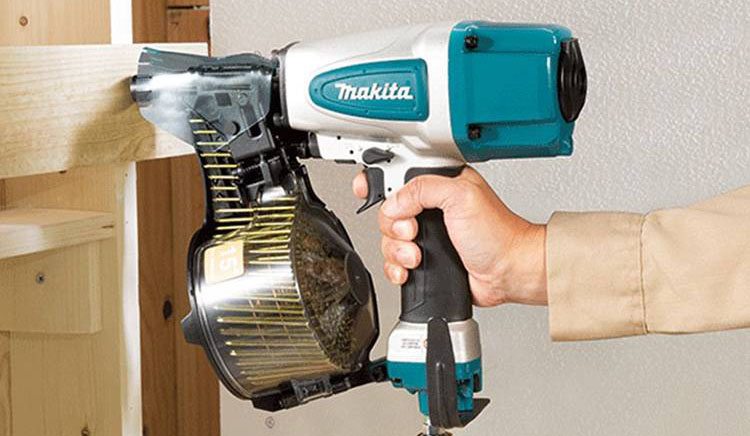
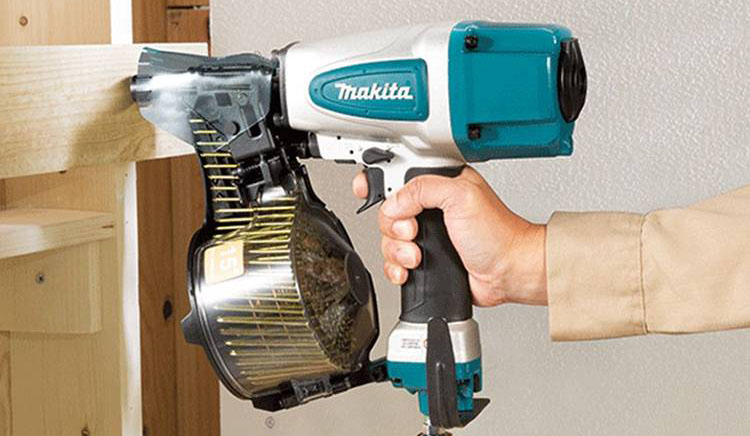
The coil nailer is a core fastening tool in industrial production and construction and decoration. With its continuous nail feeding and high-speed firing, it has completely revolutionized traditional manual nailing. It is widely used in wooden pallet manufacturing, construction, furniture production, and other scenarios, becoming key equipment for improving productivity and reducing labor costs.
1. Core Principles and Classification
(1) Working Principle
Taking pneumatic coil nailers as an example, they rely on the pressure difference between compressed air and atmosphere to drive: internal components such as cylinders, driving pins, and retractors work together. When the trigger is pulled, the driving pin (piston) reciprocates at high speed in the cylinder, ejecting coil nails from the magazine at high velocity to penetrate wood and other materials for fastening. The magazine uses a disk-type coil nail design, holding 300–500 nails per load, eliminating frequent reloading and greatly reducing downtime
2. Core Application Scenarios
(1) Industrial Manufacturing
Wooden Pallet & Skid Production: Quickly splices boards with uniform spacing and stable force, greatly improving load-bearing capacity and structural strength for container transport.
Wooden Crate & Box Manufacturing: High-speed firing supports mass production, completing hundreds of packages per hour to meet delivery schedules.
Heavy Equipment Packaging: Secures wooden frames for large machinery, glass, and other goods with strong driving force for overall stability.
(2) Construction & Decoration
Building Framing: Used for wooden structure assembly and beam-column fixing, speeding up construction.
Interior Decoration: Suitable for wood flooring, wall panels, ceiling joists, and other processes with precise operation and minimal material damage.
(3) Furniture & Customization
Ideal for panel splicing and frame assembly in custom furniture, balancing efficiency and fastening strength for various wood materials.
3. Key Purchasing Considerations
(1) Match Usage Requirements
By workload: For heavy-duty mass production (e.g., pallet factories), choose heavy-duty pneumatic coil nailers (CN90, CN100). For light-duty or flexible work, choose cordless models.
By nail length: Match nail length (37–90mm common) to material thickness; harder woods require longer nails.
(2) Focus on Core Performance
Power & Durability: High-strength driving pins and precision cylinders, with service life over 500,000 shots.
Ergonomics: Anti-slip, shock-absorbing rubber grip, moderate weight (3–4kg) to reduce fatigue.
Safety: Must include safety trigger to prevent misfires; premium models feature anti-jam and dustproof designs.
(3) Brands & After-Sales
High-end: Japanese brands such as MAX, reliable precision for high-standard jobs.
Mid-range: Stanley, SENCO, balanced performance and cost.
Cost-effective: Chinese brands such as Meite, Rongpeng, widely used in most industrial scenarios with accessible parts and service.
4. Safe Operation & Maintenance Tips
(1) Safety Rules
Confirm working pressure (6–8kgf/cm²) before use; low pressure weakens driving, high pressure damages the tool.
Disconnect air supply when loading nails; align nail heads with the guide channel to avoid jams.
Keep the nose perpendicular to the workpiece; angled firing may bend nails, jam the tool, or cause damage.
Do not dry-fire without nails to avoid wearing the driving pin and internal parts.
(2) Daily Maintenance
Lubrication: Add 1–2 drops of special pneumatic oil before and after each use.
Moisture & Dust Control: Install an oil-water separator to remove moisture; clean the magazine and body regularly in dusty environments.
Troubleshooting: Disconnect air before clearing jams; do not force disassembly. Repair or replace worn triggers and springs promptly.
5. Industry Trends
Demand for coil nailers continues to rise with prefabricated construction and furniture industry upgrading. In 2024, China’s total construction output reached 32.7 trillion RMB, with prefabricated buildings accounting for 34%, boosting sales of cordless coil nailers. Future development will focus on intelligence, lightweight, and high precision, with premium models doubling continuous runtime and improving nailing efficiency by 40% for automated production lines.
6. Summary
As an efficient and reliable fastening solution, the coil nailer is essential for pallet manufacturing, construction, furniture, and packaging. Choose based on workload, nail size, power, durability, and safety features. Proper operation and maintenance maximize performance. With industrial upgrading, coil nailers will keep innovating to support higher productivity across industries.

 Send Email
 Whatsapp